
Quick Answer
When important paper records are lost, damaged, or destroyed, a business can lose more than the documents themselves. Employees may lose access to customer information, contracts, records, invoices, or other information they need to keep working.
Creating searchable digital copies before something happens gives your business another way to access important information when the originals are no longer available.
Most businesses don’t think much about their filing cabinets until they suddenly need something inside them.
A pipe leaks. A box gets moved. Someone files a document in the wrong place. An old storage area develops moisture. Or a record simply disappears.
At Precision Integrated Data, we’ve worked with organizations that depend heavily on paper, and one thing becomes clear very quickly: paper feels permanent until it isn’t.
What Can Damage Paper Business Records?
Water is one of the most obvious threats, but it isn’t the only one.
Paper records can be affected by moisture, heat, fire, insects, age, handling, and everyday human error. FEMA records guidance identifies water damage as a particularly common source of disaster-related records damage.
Then there’s the problem that doesn’t look like a disaster at all.
That can mean time spent searching boxes, asking employees, checking old offices, and trying to recreate information that should have been easy to retrieve.
What Happens When an Important File Is Gone?
The answer depends on what was in it.
A missing personnel file is different from a missing contract. A lost medical record creates different concerns than a missing invoice or customer document.
But the business problem is similar: the information isn’t available when you need it.
That can slow decisions, interrupt customer service, delay work, and make an already stressful situation harder.
FEMA business-continuity guidance notes that storing records digitally in the cloud can help an organization continue accessing information from another device if its paper records or computers are lost or destroyed.
Which Records Should We Scan First?
Start with the records you would have the hardest time replacing.
That may include:
- Customer or patient records
- Contracts and agreements
- Personnel documents
- Accounting and billing records
- Legal records
- Historical business files
- Records required to be retained
You don’t necessarily need to scan every piece of paper in the building on day one.
Start with what matters most.
How Does Document Scanning Help?
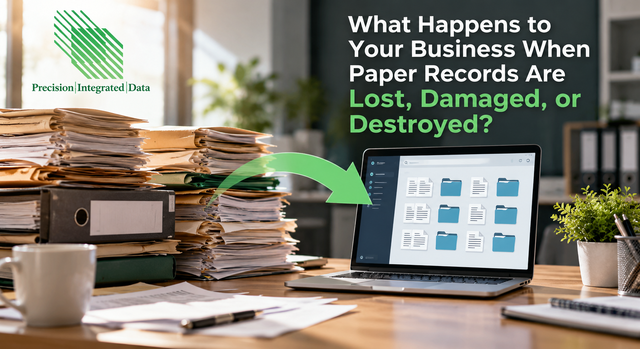
Scanning turns paper into digital files that can be organized, indexed, searched, and backed up.
At Precision Integrated Data, we convert paper documents into searchable digital files using OCR technology. Those records can then be stored digitally or placed into a secure cloud document system where authorized users can retrieve them when needed.
That means your records aren’t dependent on one filing cabinet, one storage room, or one physical copy.
What Happens to the Paper After It Is Scanned?
That depends on what your business needs.
Some organizations keep certain originals. Others choose secure shredding after they’ve reviewed and approved the digital copies.
Precision Integrated Data can return the original records or securely destroy them as part of the scanning process.
Is Your Business Too Dependent on Paper?
Here’s a simple question to ask:
Could your team still find the information it needs tomorrow if your filing room became unavailable tonight?
Should the answer make you uncomfortable, that’s a good place to begin.
Precision Integrated Data helps businesses in New Jersey, Florida, and beyond convert paper records into searchable digital information that’s easier to protect, retrieve, and manage.
You don’t have to eliminate every sheet of paper overnight.
Start with the records you can’t afford to lose.
Frequently Asked Questions
Can damaged paper records always be recovered?
No. Some damaged records may be recoverable, but serious water, fire, mold, or physical damage can permanently destroy information.
Is scanning paper records enough?
Scanning creates a digital copy, but secure storage, organization, permissions, and backup planning are also important.
Can scanned documents be searched?
Yes. OCR technology can make scanned documents text-searchable, making information much easier to locate.
Should we shred the originals after scanning?
That depends on your legal, operational, and retention requirements. Some originals may need to be kept, while others may be appropriate for secure destruction.
Does Precision Integrated Data serve businesses outside New Jersey?
Yes. Precision Integrated Data has locations in Newark, New Jersey and Tequesta, Florida and provides document-management services nationally.